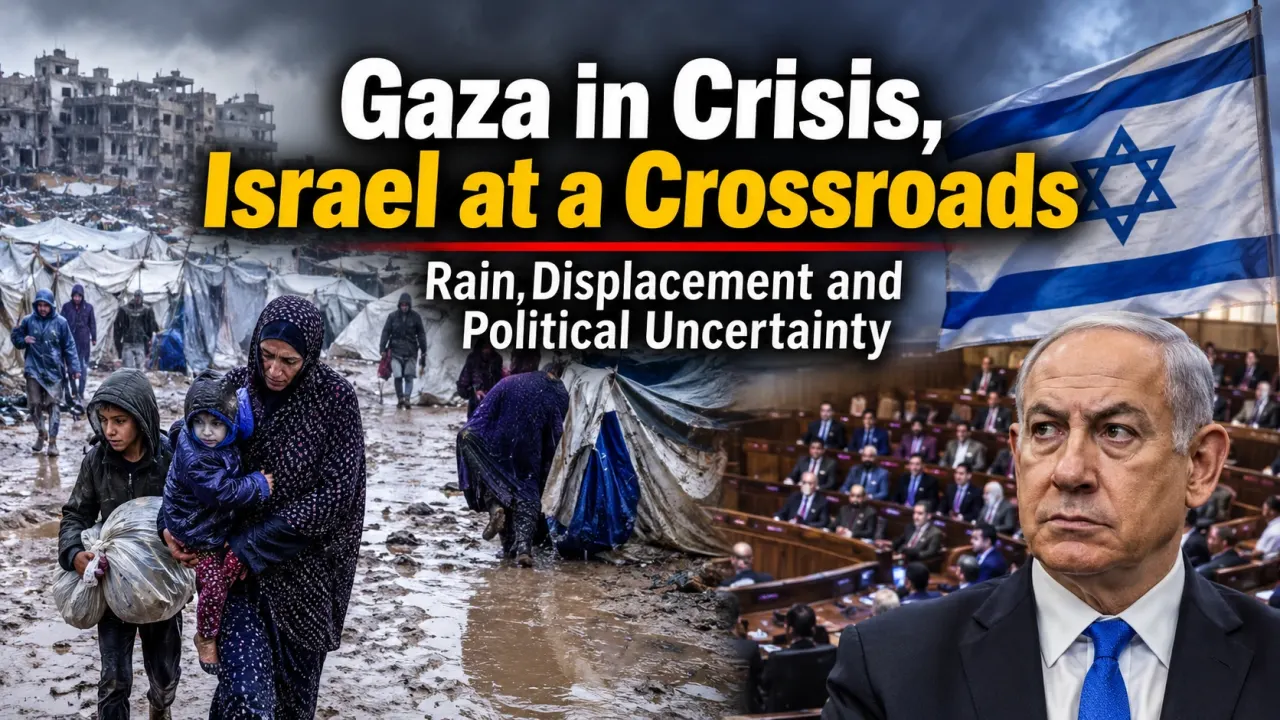
A heavy downpour over the weekend further worsened the already precarious conditions of displaced people in the Gaza Strip. Meanwhile, Israeli authorities are seeking agreements to form a government, although none of the parties is considering easing the siege on the Palestinian people.
The rain that fell on the ruins of the Gaza Strip over the weekend quickly turned into a tragedy.
Some 400,000 displaced people have been forced to live in tents for several years, following the genocide unleashed by Israeli forces against the Palestinian population in this territory, which has been described as the largest open-air concentration camp in the world.
The rain began falling on Friday, and by Saturday, streams of water had formed between the tents. Families crowded into their shelters watched helplessly as their few belongings became soaked, including medicines and the flour they use to make bread.
According to figures from the administration in the Gaza Strip, 70,000 tents were affected by the rainfall, which also caused damage estimated at 2.7 million euros.
United Nations agencies operating in the territory say they have provided assistance to the extent of their capabilities, as “available supplies are insufficient.” During these days of emergency, the UN added that “months of funding shortfalls and restrictions have severely limited preparedness.
”The force of the rain also caused structures weakened by Israeli bombardments to collapse. Those bombardments began when the attacks started in October 2023. The instability of the ground also puts dozens of other uninhabitable buildings at risk.
According to the Civil Defense, at least 300,000 tents should be distributed among Palestinians in Gaza to help them get through these days, while Israel is rejecting the construction of new homes despite the agreement reached in 2025. Although this arrangement, promoted by United States President Donald Trump, includes a board tasked with monitoring its implementation, more than 1,600 Palestinians have been added to the tragic list of people killed in recent months.
Meanwhile, in the occupied territories, Israelis are witnessing the electoral defeat dealt to Prime Minister Benjamin Netanyahu. This defeat led, a few days ago, to President Isaac Herzog’s request that opposition figure Gadi Eisenkot be called upon to form a government.
This is because Netanyahu failed to secure the necessary support in parliament (the Knesset). The current Israeli prime minister received 46 votes in the legislature, while his rival, a former chief of the general staff, secured 67.
Eisenkot will therefore have 28 days to build a consensus and form the next government.However, everything indicates that moving forward with the alliances needed to secure sufficient support to take office will force him to modify campaign promises and consider other proposals that were not part of the platform of his four-party coalition.Adding to this is the rejection of his political leadership by even more conservative factions within Israeli politics, including hardliners Avigdor Liberman and Yair Lapid, all of whom oppose the creation of a Palestinian state.Eisenkot, for his part, is also a staunch opponent of the creation of a Palestinian state.
In any case, the possibility of reaching agreements to form the new government is shaped by campaign promises to bring the Netanyahu era to an end, as well as to extend compulsory military service to the entire Israeli population. Ultra-Orthodox Jews are exempt from this obligation, and their parties in parliament pledged during the campaign to keep the exemption in place.
All in all, Eisenkot will have to assess how far he can go in negotiations to secure the 61 votes needed to form a government. At present, he can count on only 48 votes from the four parties in his alliance.If no agreement is reached, and after a short extension of the deadline, President Herzog could call on the runner-up in the election, Netanyahu. Since Netanyahu does not have sufficient support, a new vote could even be called—an outcome from which Netanyahu himself might benefit.
Under none of these scenarios does the outlook for the Palestinian people appear promising, either in Gaza or in the West Bank.
“Martín San Francisco”