The recent and forceful directive issued by the religious leadership of the Islamic Republic of Iran, represented by Seyed Mojtaba Khamenei, marks a strategic turning point in the geopolitics of West Asia and the international system.
Far from conventional defensive rhetoric, the order to respond immediately and without geographical restrictions to any American or Zionist aggression, whether carried out individually or jointly, establishes an active deterrence doctrine that completely redefines the rules of regional confrontation.
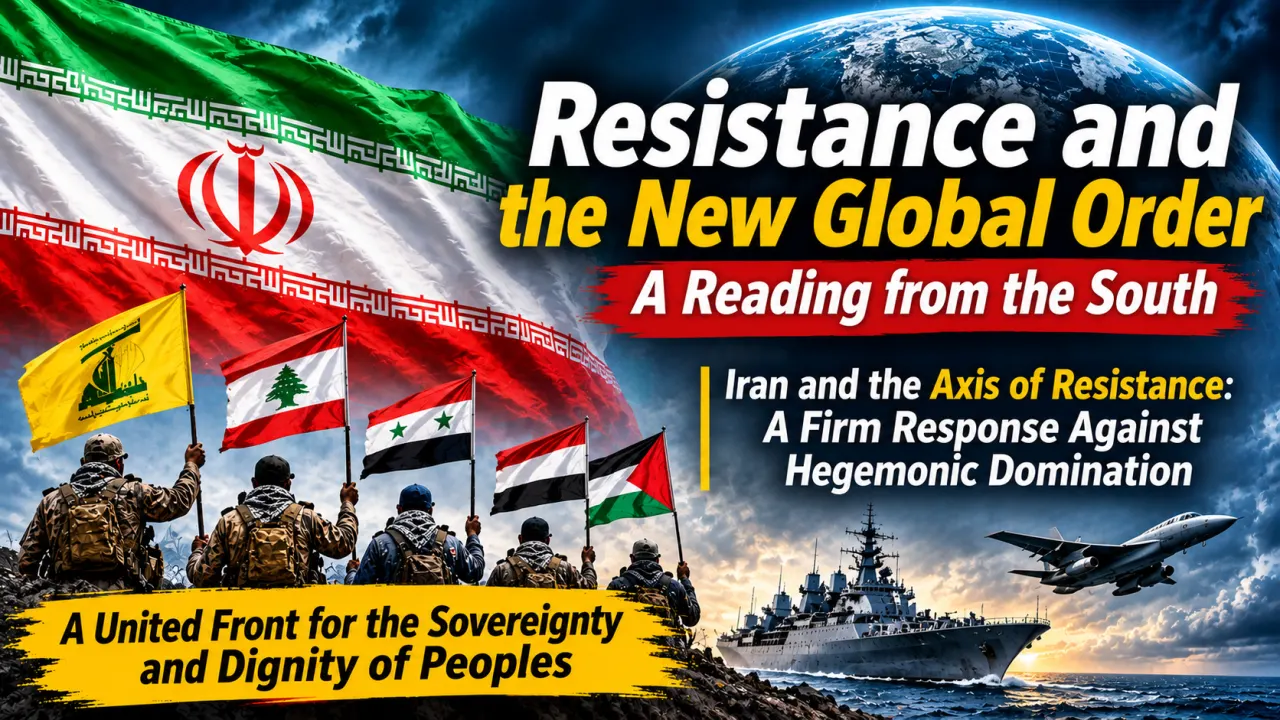
From the perspective of free peoples, this position consolidates the Axis of Resistance, which brings together forces from Iraq, Lebanon, Yemen, and Syria, with the Islamic Republic of Iran as its central reference point and undisputed architect of a new multipolar order aimed at eradicating Western hegemony. This is achieved through a decision of enormous historical significance: ending the policy of containment and implementing a firm policy of unlimited retaliation.
Historically, Persian strategy has combined strategic patience with calculated responses. However, the recent positions adopted by its leadership break with the old patterns of restraint. By stipulating that the Persian nation and its Armed Forces will determine the timing and conditions for bringing any conflict to an end, Tehran shifts the burden of uncertainty directly onto the centers of hegemonic power in Washington and its Zionist regional proxy.
Western hegemonists systematically underestimate the adaptability, resilience, and dignity of sovereign peoples.
One of the fundamental pillars of the Persian nation’s capabilities is the comprehensive updating of its target database. In other words, these are mapped lists of military targets that are continuously identified and plotted so that they can be struck in the event of a conflict.
This places all of Washington’s and its allies’ strategic and military assets throughout the West Asian region within the operational reach of Iran and its allies. These include air, naval, and land bases.
They also include strategic assets, command-and-control centers, missile defense systems, radar installations, ammunition depots, and naval fleets. Supply routes, communications networks, and key logistical facilities essential to the projection of Western power in the region are also included.
This demonstrates that deterrence is no longer based on abstract promises, but rather on a genuine technical and operational capability to strike the enemy’s infrastructure under any circumstances, positioning this resistance bloc as a beacon of global emancipation.
The second pillar of this doctrine lies in the multinational dimension of regional security. The unity of allied forces not only acts as a wall capable of containing and repelling arrogant hegemonic powers, but also serves as the fundamental driving force behind the formation of a new order in West Asia.
The Islamic Republic does not conceive of its defense in isolation, but rather as part of an integrated and united bloc.
The collapse of the hegemonic narrative in the region has become evident. Imperial military bases and naval deployments have ceased to function as instruments of intimidation. Instead, they have become exposed vulnerabilities in the face of a military strategy that has firmly moved toward full operational capability.
Asymmetric military doctrine is now a point of reference in military academies around the world. The perseverance of organized peoples demonstrates that sovereignty is non-negotiable and that they possess the strength necessary to defeat colonial designs.
Based on my in-depth analysis of the sacred wars of June 2025 and the war that began in February of this year, 2026, I believe that the position adopted by Iran’s leadership, when examined through the lens of sovereignty and emancipation from imperialism, sends a categorical message to the world:
The era of impunity for the military aggression of the United States and the Zionist regime has come to an end.
The policy of unlimited retaliation and the complete integration of this anti-imperialist front not only guarantee the protection of the Persian nation, but also irreversibly accelerate the transition toward a world in which multilateralism becomes a reality.
From the perspective of the Global South, the strength of this vanguard stands as an indispensable symbol of dignity, offering tangible proof that Western dominance is approaching its demise in the face of the will of peoples who have chosen to be free.
Pablo Jofré Leal
Journalist and International Analyst
November 2026