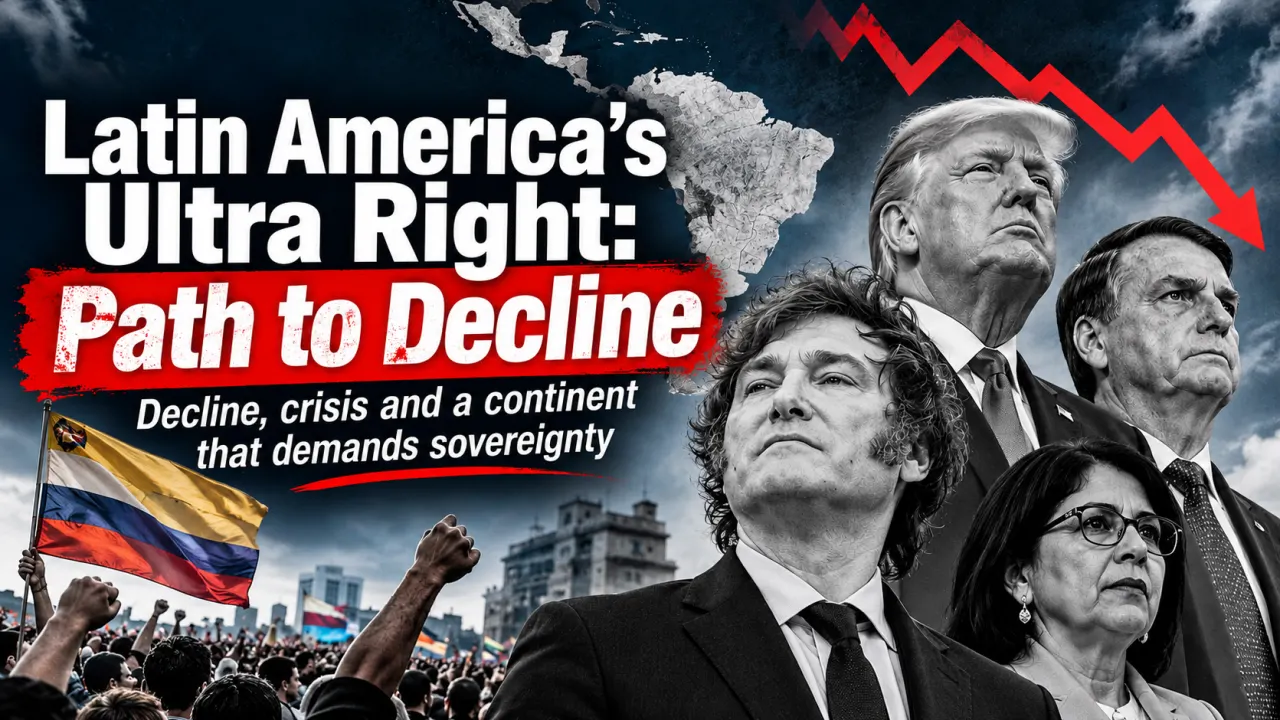
Latin America is witnessing a profound realignment of its political landscape. What was once perceived as an unstoppable wave of far-right governments is now going through a phase of acute governance crises, the erosion of radicalized leadership, and growing fatigue with economic policies that serve only the appetites of those power groups which, while occupying positions at the helm of the state, are eating away at the foundations that sustain our countries.
Far from representing a sovereign renewal, this bloc displays the symptoms of an exhausted subordinocracy. It is a reactionary structure built upon submission to hegemonic centers of power and punitive demagoguery, characteristic of those who tend to play the role of Uncle Tom (1) rather than defend their sovereignty and dignity.
The political circumstances of 2026 mark a turning point. The electoral setback suffered by Donald Trump’s administration in the United States midterm elections has thrown local political counterparts, which depended on his geopolitical umbrella, off balance. This has been compounded by the weakening of Zionism under Netanyahu and his genocidal regime, a faithful ally of the Latin American right wing and pro-Zionist groups.
Institutional turbulence exposing the fragility of the reactionary bloc is multiplying. Examples are increasingly evident in the Southern Cone and the Andean region. In Argentina, Javier Milei’s administration is moving from its rhetoric of radical rupture toward the consolidation of a new elite, sustained by opaque financial operations, regressive income transfers, and overt servility toward the Washington–Tel Aviv axis. The promise to set privileges ablaze has ultimately turned into the collapse of people’s purchasing power and the systematic dismantling of public-sector funding.
Meanwhile, Ecuador reflects the limits of corporate technocracy under Daniel Noboa’s leadership. Caught between criminal violence, curfews, and threats of further power outages, the country faces mounting social emergencies. The hard-line security discourse has essentially served as institutional cover to shield the interests of major economic conglomerates, further undermining the stability of the state.
The Latin American far-right bloc generally operates according to a logic of systematic subordination. Conservative governments and political aspirants not only align their foreign policies with the dictates of U.S. diplomacy and the Zionist lobby, but also subordinate national sovereignty to corporate and religious interests that have little to do with the needs of Latin American peoples.
This dynamic is reproduced, with local variations, throughout the continent: from Fujimorism in Peru, a historical advocate of labor deregulation and rampant privatization, to outspoken figures such as Colombia’s Abelardo de la Espriella, who embody a punitive and elitist conservatism. In Paraguay, the administration of former President Santiago Peña, who resigned from office, exposed the enormous human cost of collusion between the oligarchy and the financial system. The supposed morality of the right wing has sunk into the mire of rampant corruption.
In Brazil, the judicial saga affecting the Bolsonaro clan has revealed how moralistic fanaticism served as a smokescreen for coup-related schemes and personal enrichment. The reality? Bolsonaro Sr. is behind bars, while his sons are political turncoats operating under Washington’s protective umbrella. For them, the concept of patriotism has no substance.
In Chile, public frustration with vulgar, hypocritical, and deceptive politics paved the way for nostalgics of authoritarianism to once again display their longstanding arrogance. Government officials and lawmakers, alongside a president whose only virtue is traveling abroad to flatter hegemonic powers and bring shame upon his country.
They promise order while shielding political operators, officials, and incompetent leaders who have never fulfilled even the slightest part of their promises. This is happening in a Chile that is falling apart, where the promise that “everything is going to be all right” amounts to nothing more than vulgar rhetoric.
How is it possible that political projects with a proven harmful impact on the majority of the population continue to compete for electoral power? The answer lies in the alchemy of the new right: imported algorithms, permanent digital polarization, and the ability to manufacture imaginary enemies in order to capitalize on people’s anger and everyday insecurity.
Added to this repertoire, on the opposite side of the political spectrum, is the vulnerability created by progressive forces, which have repeatedly lost touch with the essential momentum of the structural transformations that are needed.
The current crisis of the ultraconservative axis demonstrates that its political offering has been reduced to structural dependency, social disintegration, and market-driven tyranny. For Latin America, the challenge goes beyond the electoral circumstances: it requires reclaiming comprehensive sovereignty in the face of foreign tutelage and demonstrating that the dignity of its peoples can no longer remain mortgaged in the offices of the Global North.
Pablo Jofré Leal
Journalist. International Analyst.
November 2026
Playing the role of “Uncle Tom” in a society means embodying the archetype of a person belonging to a marginalized or oppressed group who collaborates with, submits to, or seeks the approval of the dominant group at the expense of their own roots, dignity, and the interests of their community. The term originates from Harriet Beecher Stowe’s 1852 novel Uncle Tom’s Cabin.