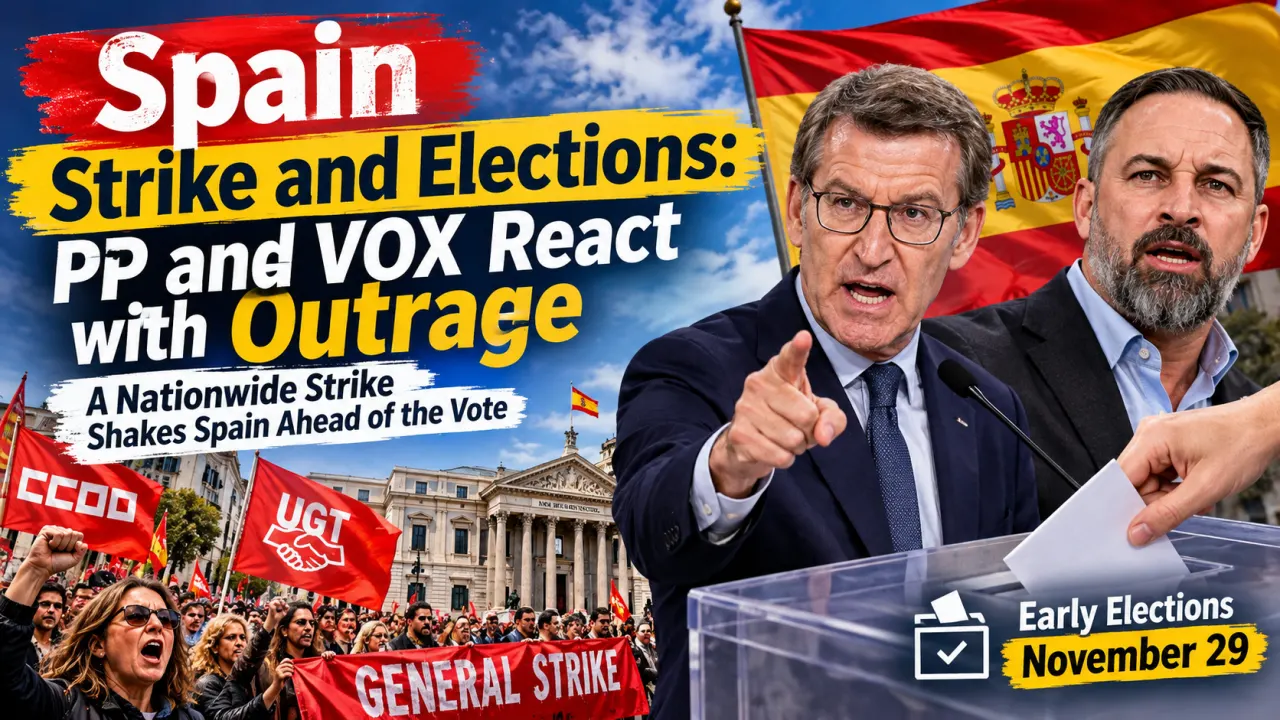
Spain’s right-wing parties expressed their anger over Wednesday’s work stoppage, which sought to demand changes to regulations governing deregulated sectors introduced during Mariano Rajoy’s administration, a government in which they also participated.
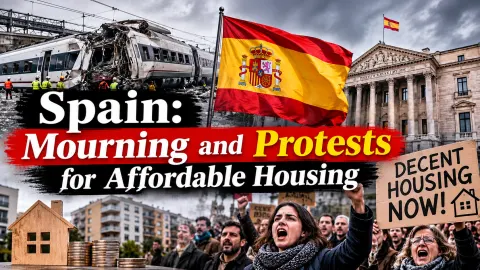
The Spanish right wing described the workers’ movement, which took place on Wednesday, November 11, as an “electoral strike.” The strike was the first of its kind in 14 years. It originated following the death of an elderly woman in Madrid who had been evicted from her home. The incident had already sparked other protests, eventually leading the country’s main trade union and social organizations to call for a nationwide mobilization.
Representatives of the Popular Party (PP) and the far-right VOX party argued that the strike, called by the Workers’ Commissions (CCOO), the General Workers’ Union (UGT), and other organizations, had an obvious political objective ahead of the November 29 snap parliamentary elections. This was because some of the protesters’ demands challenged measures originally introduced by the right itself during Mariano Rajoy’s government.
One of the main demands concerns changes to the law governing the rental and purchase of housing, which was amended under Rajoy. According to the protesters, those changes made access to housing more expensive and contributed to a sustained increase in rental prices, particularly in Spain’s largest cities.
Other demands included addressing rising prices and the overall deterioration in living conditions. Workers also called for a reduction in working hours without any corresponding cut in wages.
The Popular Party was so angered by the labor mobilization that Isabel Díaz Ayuso, president of the Community of Madrid, described the strike as an act of trade union organizations “holding workers hostage,” claiming that some employees might otherwise have wanted to go to work. She also called on Alberto Núñez Feijóo, who is expected to become Spain’s next prime minister, to put an end to what she described as “trade union rubbish.”
All the estimates published so far suggest that candidates from the PP and VOX are likely to win enough parliamentary seats between them to form the next government, with Núñez Feijóo at its head.
According to figures released on Monday, November 9, the PP is projected to win 129 seats, while the PSOE, led by current Prime Minister Pedro Sánchez, would obtain 119. VOX is expected to secure 61 seats and the Broad Front 10.
This would allow Feijóo to surpass the minimum of 176 votes required in the Cortes Generales, Spain’s parliament, while campaigning on criticism of Sánchez’s administration, particularly regarding immigration and security.
An editorial published in a nationally circulated Spanish newspaper also criticized the current socialist government for having built “only” 170,000 homes during its term, which began on November 16, 2023. To emphasize the contrast, the editorialist, who sent the article from the United States to El Mundo, cited the 40 million homes allegedly built during Francisco Franco’s dictatorship. If that figure were accurate, it should be remembered that the Franco regime, which was allied with the Nazis during World War II, remained in power in Spain from 1939 until November 20, 1975, when the dictator died — a period of 36 years.
Within the Spanish government, officials are looking to recent electoral victories against Republican candidates in Brazil and the United States as a possible sign of hope that the projections for Spain’s November 29 elections could be overturned.
In an interview with El País, Foreign Minister José Manuel Albares described the two political projects competing in the upcoming elections as fundamentally different. One, he said, is “progressive, focused on people, on their concrete needs, and on respect for international law,” while the other “believes in confrontation and the law of the strongest.
”The head of Spanish diplomacy said he was “certain that the wave beginning in Brazil and continuing in the United States will reach Spain.
”That is why, just 24 hours after the general strike, Pedro Sánchez’s government rejected the harsh criticism directed at the mobilization by the PP and VOX.
Government spokesperson Elma Saiz called for “respect for trade unions and respect for a constitutional right: the right to strike, which is recognized and protected as a fundamental right.”Meanwhile, Minister for Social Rights and Consumer Affairs Pablo Bustinduy announced: “I will do everything possible to help make the strike a success. My support is sincere, firm, and absolute.”
The PP and VOX described the mobilization as a historic mistake. However, the Workers’ Commissions (CCOO) and the General Confederation of Labour (CGT) declared the strike a success in the country’s major cities, reporting work stoppages across several sectors, including ports, energy, transport, and industry.
What is certain is that the election campaign has now begun, and Spaniards are being called upon to choose their next government between two opposing political projects with radically different visions for the country.
“Martín San Francisco”