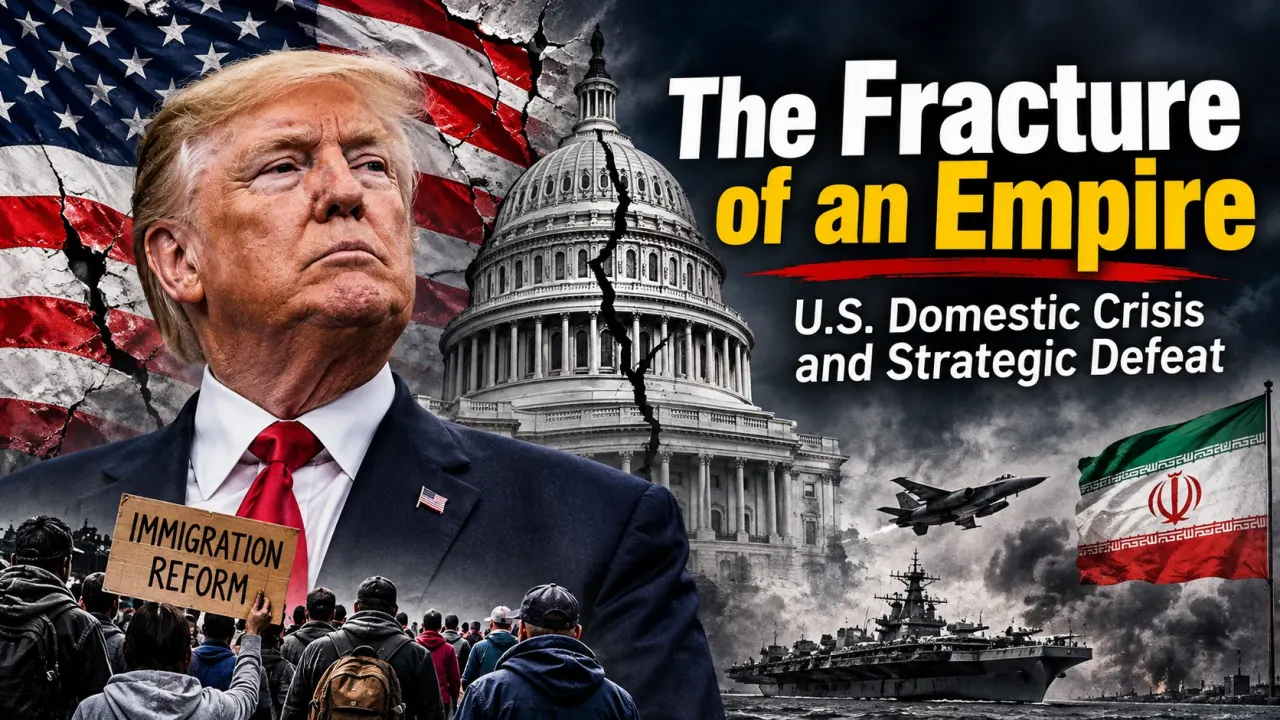
The American political system is undergoing a period of profound restructuring, in which the costs of maintaining hegemony, both domestically and internationally, are beginning to fracture the foundations of the second administration of Donald Trump, the current occupant of the White House.
This situation has been further exacerbated by the electoral setback in the midterm elections held on November 3.
In recent statements made during an interview on an American television program (1), President Donald Trump acknowledged that his immigration policy may have been “too harsh.” This evident crisis is intertwined with another crisis of strategic proportions: calls for the removal of Secretary of War Pete Hegseth, spearheaded by factions within the Democratic Party in response to the failed and costly military aggression against the Islamic Republic of Iran.
From a critical international perspective, these two developments are not isolated events. They represent two sides of the same coin: the exhaustion of a doctrine based on hegemony and the use of unlawful force, both within American borders and, above all, across the map of West Asia.
Domestically, the machinery of mass deportations and the unchecked actions of the so-called Immigration and Customs Enforcement (ICE), which has come under scrutiny following incidents of institutional violence, repression, and even killings, led to a sharp decline in Trump’s public approval rating to 39%, exposing the unsustainability of governing under the stigma of exclusion.
Trump’s own acknowledgment that long-established workers had been deported, along with internal dissent expressed by Republican voices such as Senator John Cornyn, reflects how the social fracture has already permeated the ultraconservative establishment.
The politics of humanitarian contempt, which reduced the complexity of immigration to a police crackdown, collided head-on with the demographic and economic realities of entire communities, particularly Latin American ones.
This translated into an electoral defeat that forced the White House to embark on an unusual rhetorical retreat.However, while Washington attempts to gloss over its immigration excesses in an effort to appease public discontent, the Pentagon’s foreign policy is deepening a geopolitical abyss with unpredictable consequences.
Pete Hegseth’s handling of the war of aggression, alongside the Zionist Israeli regime against Iran, has been described by Democrats as an “irresponsible war of aggression” that is damaging the American economy without delivering any legitimate security benefits.
The United States’ strategy in West Asia has systematically underestimated national cohesion and the capacity for resistance of the Islamic Revolution and, more broadly, the Axis of Resistance. The “maximum pressure” plans, unilateral coercive measures, and military adventures promoted by Washington and its Zionist allies inevitably run up against a wall of strategic resistance.
Every incursion or escalation driven by Trump not only exposes the fragility of a declining hegemonic project but also accelerates the country’s deterioration in key regions where the peoples of the Global South are resisting imperial aggression.
These arguments lead us to maintain that the main person responsible for the political, economic, and military debacle is the US president himself. It is an act of cowardice to assign lower-ranking officials responsibility for the chaos engulfing the United States, using them as scapegoats (2).
Thus, the internal crisis of the Trump administration reveals a two-pronged predicament: the inability to sustain a model of immigration persecution that alienates its own electorate, and the recklessness of an external aggression against Iran that is failing and coming up against the sovereign resolve of the Iranian people.
The American empire retreats in bewilderment in the face of the ballot box and collides with its own geostrategic limitations, demonstrating that absolute coercion, both on the streets of the United States and in the Persian Gulf, has become its greatest source of vulnerability.
This multidimensional failure confirms that the sovereignty and dignity of peoples cannot be subdued by imperial arrogance. On the contrary, it demonstrates that Western unilateralism is not only collapsing in its attempt to subjugate the Persian nation, but is also imploding from within as it stumbles over the contradictions of a model of global domination that is dying in the face of the emergence of a new multipolar order.
Pablo Jofré Leal
Journalist. International Analyst.
November 2026
1.https://www.usatoday.com/story/news/politics/2026/11/09/trump-60-minutes-interview-takeaways/92688767007/
2.https://www.bbc.com/mundo/articles/ck8dz3494l5yo