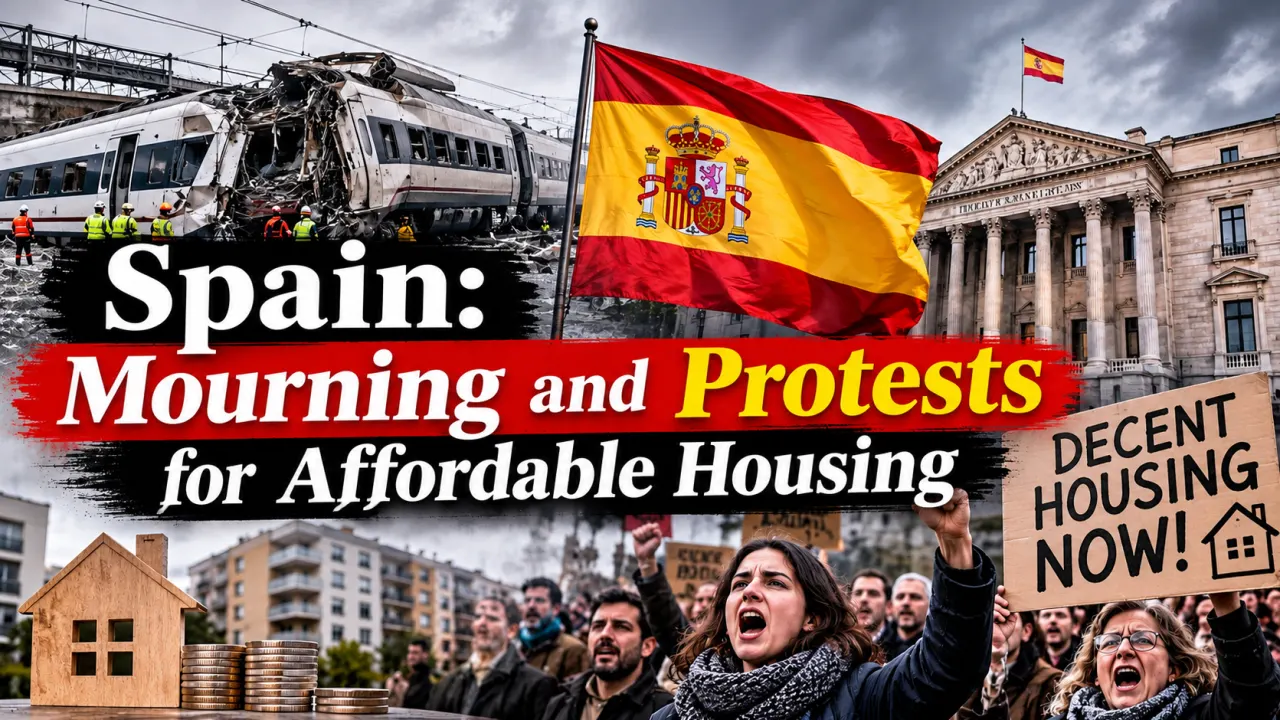
Spain is in mourning today following the tragedy caused by the collision of two trains, which left at least 69 people dead and dozens injured, while several people remain missing.
Among the victims was Fátima Báñez, a former minister in Mariano Rajoy’s government. Her body had to be recovered from the twisted wreckage left by the fatal collision, which occurred on Wednesday in the town of Urda, Toledo, about 140 kilometers south of the capital, Madrid.The tragedy appears to point to human error in communications between the railway system’s control center, which ordered the use of a high-speed track.
The case is being investigated by the authorities, while King Felipe VI has joined calls for answers and for those responsible to be held accountable.The accident has cast a further cloud of pessimism over the mood in Spain, where voters are due to go to the polls early on November 29.
The early election was called after Prime Minister Pedro Sánchez informed the head of state, King Felipe, of his decision to dissolve the Cortes Generales (Parliament), following the Congress of Deputies’ refusal to ratify housing-related decrees. The country is facing a genuine housing crisis, which has sparked a series of demonstrations.
The demand for access to decent housing and for workers to regain their purchasing power forms part of the platform behind a general strike called for November 11 by the Workers’ Commissions (CCOO) and the General Workers’ Union (UGT).
For decades, Spain promoted home ownership over renting. This model ultimately collapsed in the wake of the 2008 economic crisis, which led banks to tighten the conditions for mortgage financing. The stricter terms left many Spaniards unable to access a roof over their heads.
This profound shock to Spain’s economic and social structure became even more pronounced under the right-wing government of Mariano Rajoy (2011–2017), who introduced a series of legal reforms that exacerbated the difficulties of accessing housing.
For example, during his term in office, the subsidy for home purchases was abolished, and the legal terms governing property rentals were also changed: lease contracts were reduced from five years to three, while automatic renewals were shortened from three years to one. This allowed property owners to raise rents at shorter intervals, creating a new source of uncertainty for tenants.
This combination of factors led to a sharp and sustained rise in rental prices, alongside a shortage of available housing in urban centers where most of Spain’s population is concentrated, such as Madrid, Barcelona, Seville, and Valencia. These cities also have the country’s highest rental prices. By contrast, in inland towns with less economic activity, populations are declining and housing is cheaper.
In response to this situation, Pedro Sánchez’s government had proposed amendments through a decree. However, when the measure was put before the Congress of Deputies, it was rejected by the right-wing parties and the regional political party Junts per Catalunya.
The government’s measures proposed reinstating subsidies for families and young people to help them purchase their first homes, as well as providing new funding for the sector and stimulating the construction of around 15,000 homes per year.
However, deputies from the People’s Party (PP), the far-right Vox party, the Navarrese People’s Union (UPN), and the aforementioned Junts per Catalunya rejected the initiatives. They criticized the lack of consultation with the regional governments and the lack of legal certainty for property owners, while also questioning the funding that the government had pledged for this package of measures.Meanwhile, Spaniards continue to see real wages stagnate, with people having to spend as much as 50 percent of their income on rent.
This is compounded by the rising cost of living in general, not only in Spain but also in most European countries. In recent months, these countries have witnessed popular demonstrations in several major cities, including Barcelona and Milan, as well as in Serbia and France, where student demands have also focused on serious infrastructure problems in public educational institutions.
“Martín San Francisco”