

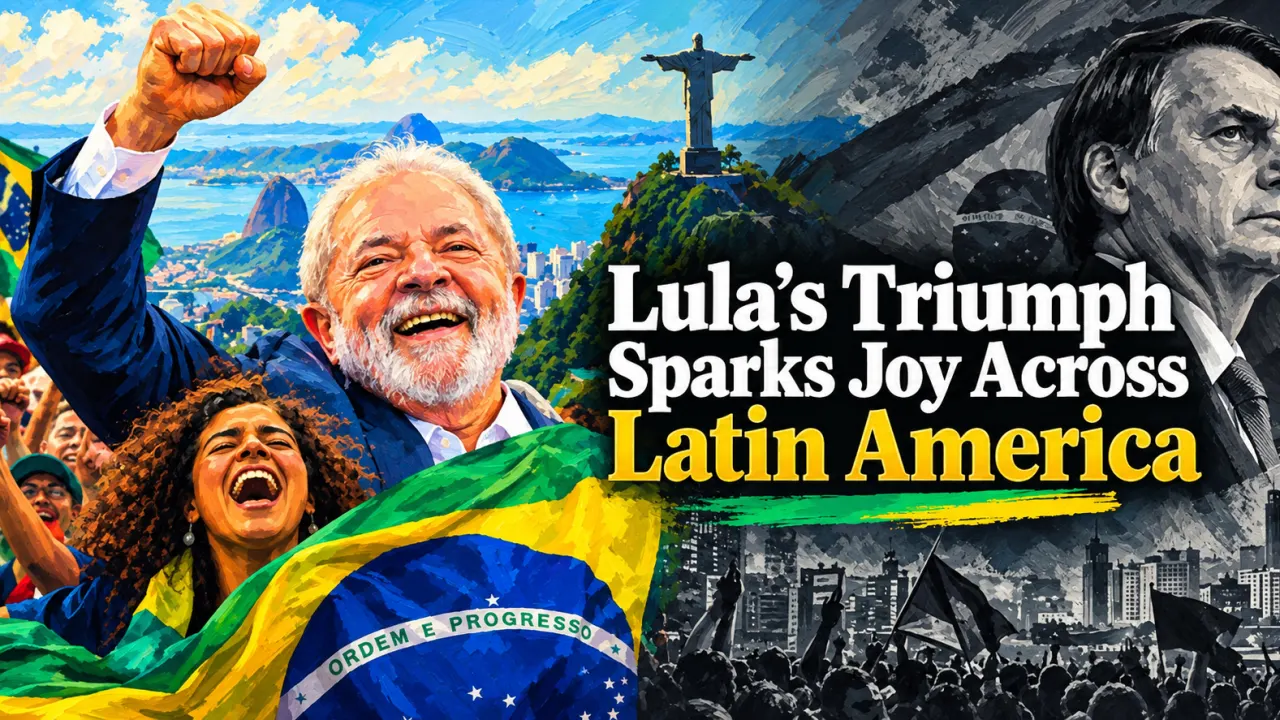
Lula’s re-election transcended Brazil’s borders, spreading the carnival-like celebrations that erupted on Sunday night in the land of samba to the rest of the region.In Buenos Aires, Santiago de Chile, Lima, Bogotá, and Quito, progressive sectors celebrated the victory, which had taken on epic proportions. They had watched with apprehension and concern the possibility that far-right politician Flavio Bolsonaro might win the presidency.
For Donald Trump’s administration, securing Bolsonaro’s arrival at the Planalto Palace, the seat of government in Brasília, would have been the crown jewel after succeeding in bringing representatives in Chile, Argentina, Peru, Ecuador, and Colombia into power who followed Washington’s dictates and implemented its policies. In Washington, these policies are referred to as the “Donroe Doctrine,” a blend of “Donald” and “Monroe.”
Dating back to the 19th century, the doctrine maintains that Latin America is the United States’ backyard.That is why Lula’s speech at the United Nations on September 22, when he declared that “Brazil is nobody’s backyard,” was aimed precisely at resisting attempts by the United States to impose its agenda on the largest country in the Latin American subregion, which also has the region’s largest economy and accounts for one-third of the population stretching from Mexico to Patagonia.Although, days later, on October 4, the former metalworker and trade union leader failed to defeat Bolsonaro in the first round, the prospect of the far-right senator taking the presidential sash mobilized the entire country.
Brazilians took to the streets for concerts featuring some of the country’s most prominent musical artists, including Caetano Veloso, Djavan, Chico Buarque, Maria Bethânia, and Daniela Mercury, to name just a few.
They were joined by massive marches in São Paulo, Rio de Janeiro, Salvador da Bahia, and Brasília, as well as movements involving athletes who used their respective sports to demonstrate their rejection of any reversal of the democratic and social progress the country had made in recent years.
Another factor that played a major role in Brazil’s runoff election was the use of social media. On the day of his victory, Sunday, October 25, Lula was accompanied by André Janome, a congressman-elect from Minas Gerais and the creator of the so-called “Lula Army” on social media. He has more than 10.5 million followers on WhatsApp, who were mobilized during the campaign to repost stories and reels designed to contrast Bolsonaro’s content with the prospect of continued progress in social rights, including increases in the minimum wage and access to higher education for the country’s poorest sectors.
Janome’s strategy appeared to pay off, and Lula showed his appreciation by having him stand beside him on stage in São Paulo on the night of October 25, when he delivered his speech after being officially proclaimed the election winner by the Superior Electoral Court.On the other side, Flavio Bolsonaro refused to acknowledge Lula’s victory, announced that he would seek to have the election annulled, and said he would organize fierce opposition to the incoming government of the Workers’ Party (PT) leader in Parliament, which is predominantly composed of Brazil’s right-wing forces.
However, this challenge does not appear to discourage the octogenarian president, who turned 81 on Tuesday the 27th. In his speech on Sunday night, Lula acknowledged the composition of his country’s Congress and said that he would have to work there to pass legislation benefiting Brazil’s 214 million people.He also outlined several ideas for his next term, which will run until 2030. The first is to establish regulations governing fake news, which spreads like wildfire across social media. “It cannot be the case that there are no sanctions,” the head of state warned.Another issue likely to generate tensions in the country is the announcement that responsibility for managing the police forces, which are tasked with ensuring public security, will be returned to the federal government.
The 1988 constitutional reform established that each state should have its own police force. This arrangement has led to operational overlaps and overlapping armed-control responsibilities, as well as allegations that some of these forces have links to criminal gangs that have had a profound impact on Brazilians’ lives.Among other proposals, Lula stated that Brazil must stop importing scientific development and artificial intelligence and instead become a global hub capable of developing its own tools, primarily to strengthen production and improve the living conditions of its people.
Just one day after his defeat, Flavio Bolsonaro refused to surrender his passports to the authorities investigating him for money laundering and corruption. Although Supreme Federal Court Justice Alexandre de Moraes granted him 24 hours to hand over the documents, the defeated presidential candidate ultimately fled to the United States, where, according to sources within the Trump administration, he was granted asylum.Meanwhile, his father, former President Jair Bolsonaro, will have to continue serving his 27-year-and-three-month prison sentence for attempting a coup against Luiz Inácio Lula da Silva himself in an effort to prevent him from taking office on January 8, 2023. His son Flavio had previously announced that he would pardon his father once he assumed Brazil’s presidency.
However, neither this promise nor his project of subjecting Latin America’s largest country to American neocolonialism will come to fruition.
“Martín San Francisco”